To map wildebeest migration movements, trace a loose clockwise circle through the Serengeti in Tanzania and the Masai Mara in Kenya. Around 1.5 million wildebeest, joined by hundreds of thousands of zebra and gazelles, follow the rain and fresh grass. They calve on the southern plains from January to March, move north through the central and western Serengeti from April to June, reach the northern Serengeti and the Mara River from July to October, and return south in November and December.
There is no start or finish line, and the exact dates shift with the rains. This article gives you the full route, a month-by-month table of where the herds usually are, and a way to match that map to your own travel dates. It also covers what no map or tracker can tell you, so you know how much weight to give them.
We run private guided safaris from Arusha, and our founder has guided in Tanzania and Kenya since 2012. The advice below comes from planning trips around this loop, so you can use it to choose a month, a region and a base.
Why a wildebeest migration map matters for your trip
A migration map matters because the herds sit in a different part of the ecosystem every month, and booking the right park in the wrong month can mean an empty plain. The map tells you which region to base yourself in for the dates you can travel.
What a migration map actually shows
A migration map plots the usual position of the main herds in each month along a loop that crosses the Tanzania and Kenya border. The red patch on most maps is an average of many years, not a photograph. Herds spread across a broad front, and smaller groups peel off or lag behind.
The loop exists because the animals chase fresh grass and drinking water. Rain falls in different places at different times, so the herds follow it. The route is commonly quoted at about 500 miles (800 km) a year, though animals zigzag and walk more than that.
The migration is a loop with no starting line, so the only question that matters is where the herds usually are in your month.
Why timing beats park choice
Choosing "the Serengeti" is not enough, because the park is huge and the herds occupy only part of it. In February the southern plains hold the calving herds, while the north holds few migrating animals. The ground distances between the southern plains and the Mara River are long, so you cannot easily drive between the two in an afternoon.
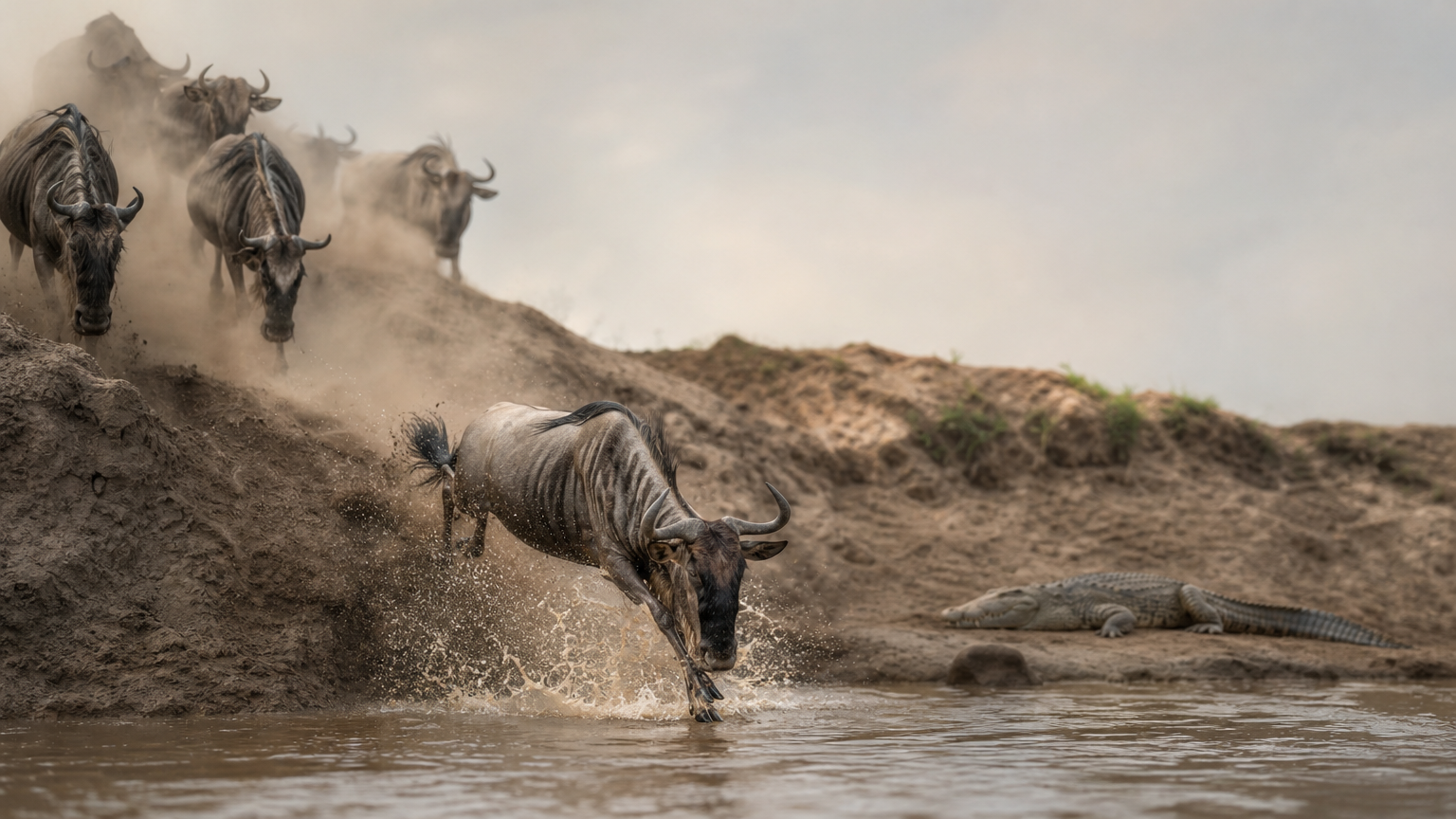
Each stage of the loop also offers a different experience. Calving brings newborn calves and active predators. The river crossings bring panic, crocodiles and large crowds of vehicles. Knowing which one you want narrows your dates quickly.
The month-by-month route through the Serengeti and Mara
The herds spend the first quarter of the year on the southern plains, travel north between April and June, cross into the Mara between July and September, and come back south by December. The table below combines the typical pattern, which varies each year with the rain.
Month-by-month at a glance
Use this table as your working map. Months at the edges of a stage, such as April, October and November, are the least predictable.
| Month | Where the main herds usually are | What is happening |
|---|---|---|
| January | Southern Serengeti, Ndutu, northern Ngorongoro Conservation Area | Grazing on short grass, calving starts late in the month |
| February | Same southern plains | Peak calving, most calves born in a 2 to 3 week window |
| March | Southern plains, spreading out | Last calves born, herds begin to gather |
| April | Moru Kopjes and Seronera | Herds start moving north |
| May | Central and western Serengeti | Large columns of wildebeest, zebra and gazelles |
| June | Western Corridor, south bank of the Grumeti River | Herds bunch up before crossing the Grumeti |
| July | Grumeti Reserve, Ikorongo, northern Serengeti | Leading herds reach the Mara River late in the month |
| August | Northern Serengeti and Masai Mara | Mara River crossings |
| September | Northern Serengeti and Masai Mara | Crossings continue, herds turn south late in the month |
| October | Loliondo and the Lobo area, with stragglers in the Mara | Return south begins |
| November | Eastern short-grass plains | Herds arrive with the short rains |
| December | Southern Serengeti and Ndutu | Herds gather ahead of calving |
The calving and northward stages, January to June
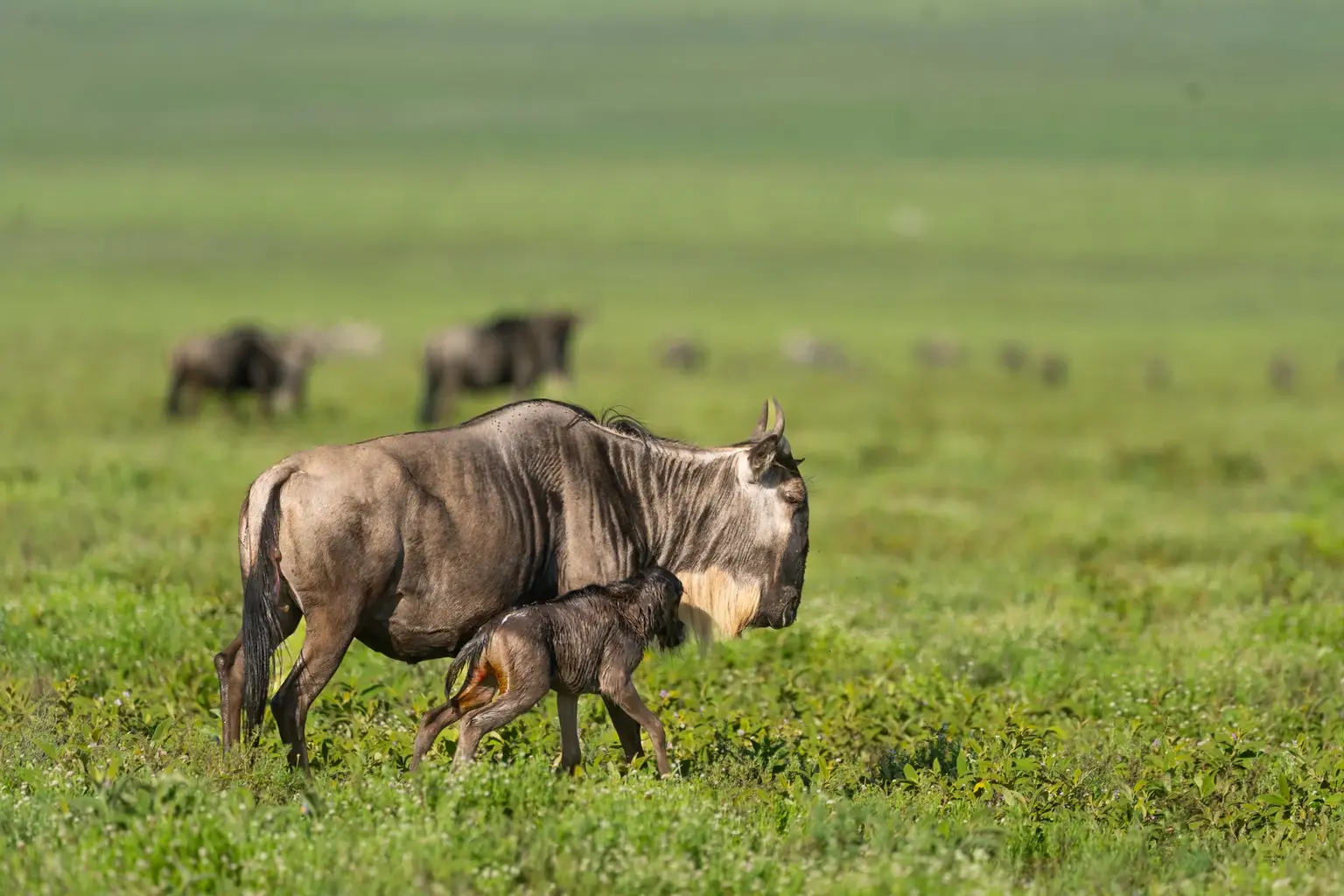
The southern plains around Ndutu are where the year begins for the herds. Calving peaks in February, and the calves can stand and run within minutes. Lions, hyenas and cheetahs hunt the plains throughout, which makes this the most predator-heavy stretch of the cycle.
By April the grass dries and the herds start north through Moru Kopjes and Seronera. In May they move in long columns across the central and western Serengeti. In June they pile up at the Grumeti River in the Western Corridor. The river is a series of pools and channels with crocodiles, but the crossings are usually less dramatic than those at the Mara.
Calving in the south, the Grumeti in June, the Mara from late July: those three anchors hold the whole year together.
The crossing and return stages, July to December
From July the herds spread across a broad front in the north. The Mara River crossings usually run from late July through September, though some herds cross earlier or later depending on the rains. Herds often cross north one day and back south a few days later, so one crossing does not mean the herd has left.
In October the herds head south through western Loliondo and the Lobo area. By November the short rains arrive and the herds reach the eastern plains. In December they spread across the southern Serengeti and Ndutu, and the cycle begins again.
How to use the map to plan your safari
Pick the stage you want to see, set your dates inside that window, and base yourself in the region the table gives for those months. Then leave room for the rains to move things by a couple of weeks.
Match what you want to see to a month
Start with your goal, then read off the months and base. This keeps you from choosing dates first and hoping the herds cooperate.
| Goal | Best months | Where to base |
|---|---|---|
| Calves and predators | January to March, peak in February | Ndutu and the southern Serengeti |
| Columns of herds on the move | May to June | Central and western Serengeti, Western Corridor |
| Mara River crossings | Late July to September | Northern Serengeti and Masai Mara |
| Herds returning south | October to November | Loliondo, Lobo, eastern plains |
For calving, our 8 Days Southern Serengeti Migration Safari is a private Ndutu trip through Tarangire, the Serengeti, Lake Ndutu, Ngorongoro Crater and Lake Manyara. Lake Ndutu is the main target from December to April, and February is the best time for calving.
Build flexibility into your dates
Rain moves the herds, so stay at least a few nights in your target area instead of passing through in a single day. A private guide can then adjust each morning to wherever the animals have moved. Do not treat a map position as a promise for a specific date.
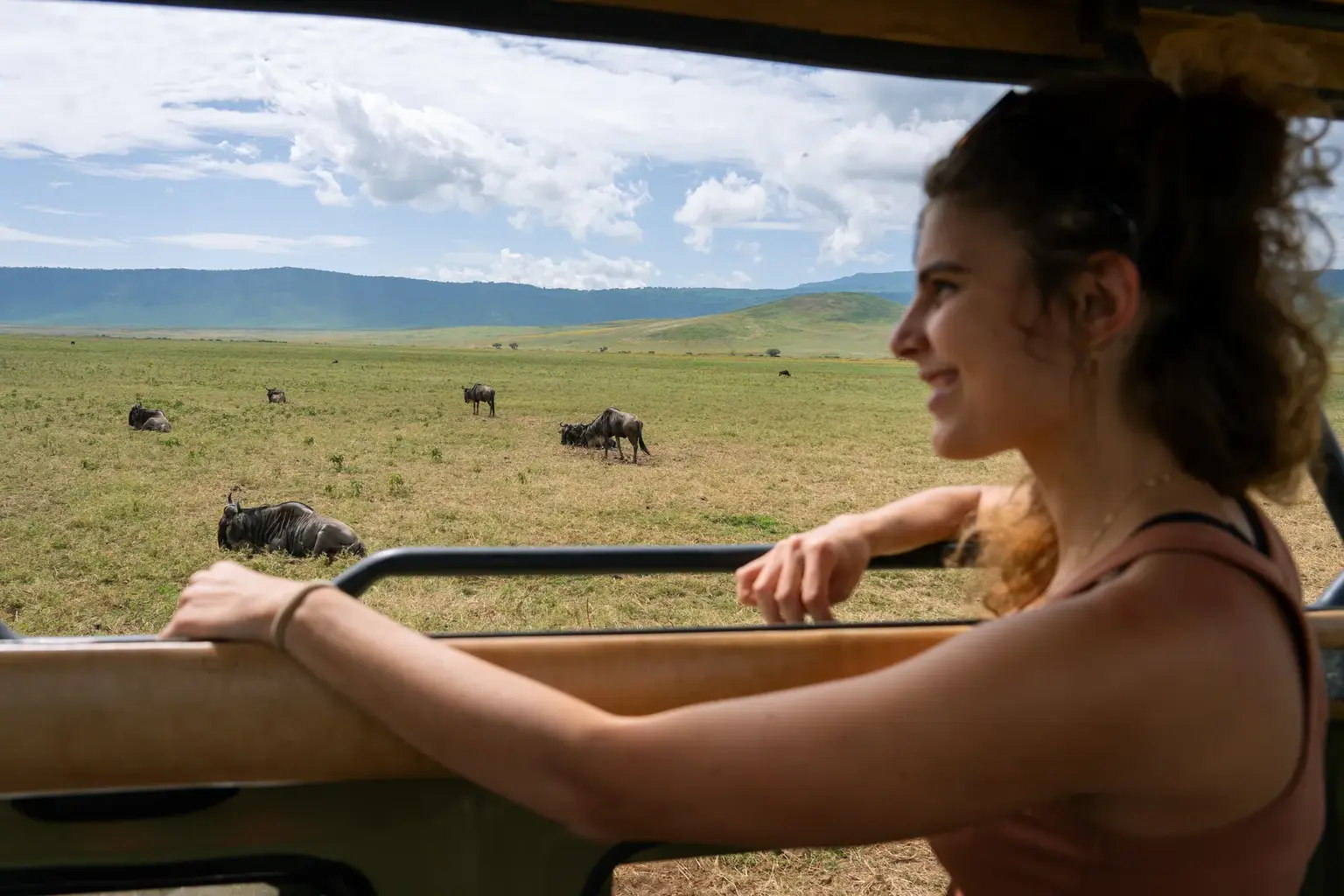
Because the northern herds spend time on both sides of the border, a route that covers both countries gives you two chances to find them. Our 6-Day Kenya & Tanzania Mid-Range Safari covers the Masai Mara, the Serengeti and Ngorongoro Crater. Our 8 Days Kenya & Tanzania Safari adds Mto Wa Mbu village and Tarangire National Park.
Choose your stage first, your dates second, and keep several nights in the right region so the herds have time to find you.
Where maps fall short and how to track the herds
Every migration map is a guide to typical patterns, not a live feed. Herds scatter, split and reverse, and the best current information comes from people who were on the ground in the last few days.
Why no map is exact
Rainfall decides where the grass is green, and rainfall varies every year. A late rainy season can hold the herds in one area for weeks, and an early one can send them on. The map's single red patch also hides the fact that large groups are often miles apart. Part of the herd can be in the Mara while another part is still in the Serengeti.
The answer to "where is the biggest herd?" is also seasonal. The largest concentrations are usually on the southern plains during calving, from January to March. The most dramatic scenes, though, happen at the Mara River from late July to September.
How to check where the herds are now
Use the table for the broad picture, then confirm with current information. A herd tracker is useful, but only if its reports are recent and come from people on the ground. Follow this routine:
- Find the stage for your month in the table above.
- Ask your operator for guide and camp reports from the last few days.
- Ask whether the rains were early, late or normal this season.
- Treat any report older than about a week as history, not a forecast.
- Keep one day in your itinerary free to move if the herds shift.
A map tells you where to look, and a recent field report tells you where to drive.
Reading the map before you book
The migration is one continuous loop: calving in the south, a push north, the river crossings in the north and the Mara, and a return south. Read it by stage, choose the stage you want, and base yourself where the herds usually are in that month. Then leave room for the rains, because no map can promise the exact day.
If you want help turning the route into dates, parks and lodging, talk to our team at Passionate Guides Tanzania. We will match your travel window to the right stage of the migration and build a private itinerary around it.