The answer to how many wildebeest in the Great Migration depends on who is counting. The long-standing estimate is about 1.3 million wildebeest, travelling with 200,000 to 300,000 zebra and several hundred thousand gazelles. Travel sites round this up to 1.5 or even 2 million animals, while a recent scientific reassessment put the wildebeest count below 600,000. The Great Migration is the circular, year-round movement of these herds between Tanzania's Serengeti and Kenya's Maasai Mara, driven by rain and fresh grass.
This guide explains why the headcount matters, how counters arrive at it, and why the published figures disagree so widely. It also covers what zebra, gazelle and newborn calves add to the total. You will see how to use the numbers when you plan a trip, because the most useful figure is not always the biggest one.
Passionate Guides Tanzania is a small, founder-led safari operator in Arusha, and our founder has guided in Tanzania and Kenya since 2012. Guests ask this question early in their planning. Nobody knows the exact figure, but you can know a lot about what the number means.
Why the wildebeest count matters
What the number tells conservationists
The wildebeest headcount is the simplest health check for the whole Serengeti-Mara ecosystem. These animals graze the plains short, return nutrients as dung, and feed lions, hyenas, cheetahs and crocodiles. When their numbers move, grass, predators and tourism move with them. The best-known swing followed the control of rinderpest in the 1960s, when the population recovered from roughly 250,000 animals to well over a million by the late 1970s.
The wildebeest count is the health check for the entire Serengeti-Mara ecosystem.
Today the pressures are different. Farming, fencing and settlement at the edges of the route can narrow the routes the herds depend on, so an accurate count shows whether the system is holding up.
What the number means for your safari
For a traveler, the count sets the scale but not the experience. Even the lowest estimate means hundreds of thousands of animals moving as one connected population, spread over an area so large that you never see the whole herd at once. What decides your view is where the herds are in the month you travel.
The Great Migration happens only in Tanzania and Kenya. The herds spend most of the year on the Tanzanian side, so Tanzania hosts the larger share of the animals for most of the calendar.
How the herd gets counted
Aerial sample surveys
Wildebeest are counted from small aircraft, not one by one. Researchers fly fixed survey lines at a set height, count or photograph animals in a narrow strip on each side of the plane, and scale that sample up to the whole survey area. Dense groups are tallied from photographs, because no observer can count thousands of moving animals by eye.
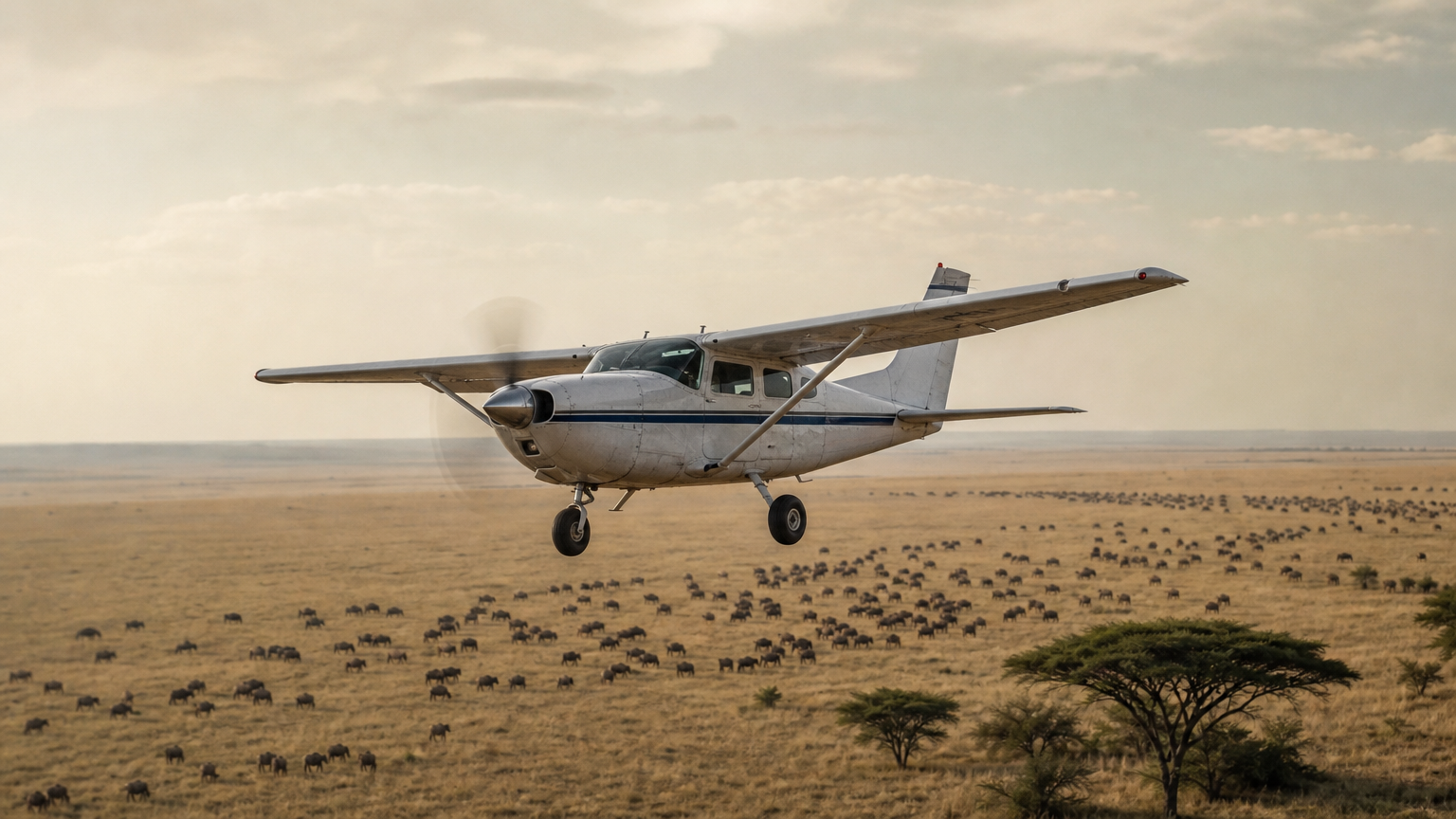
The result is an estimate with a margin of error, not a census. The herds also keep moving, so each survey is a snapshot of one season. GPS collars on a few animals show where herds travel, but they do not tell you how many animals there are.
Every wildebeest figure is a sampled estimate with a margin of error, never a census of individual animals.
How to read any figure you see
Run any number you meet through five quick checks:
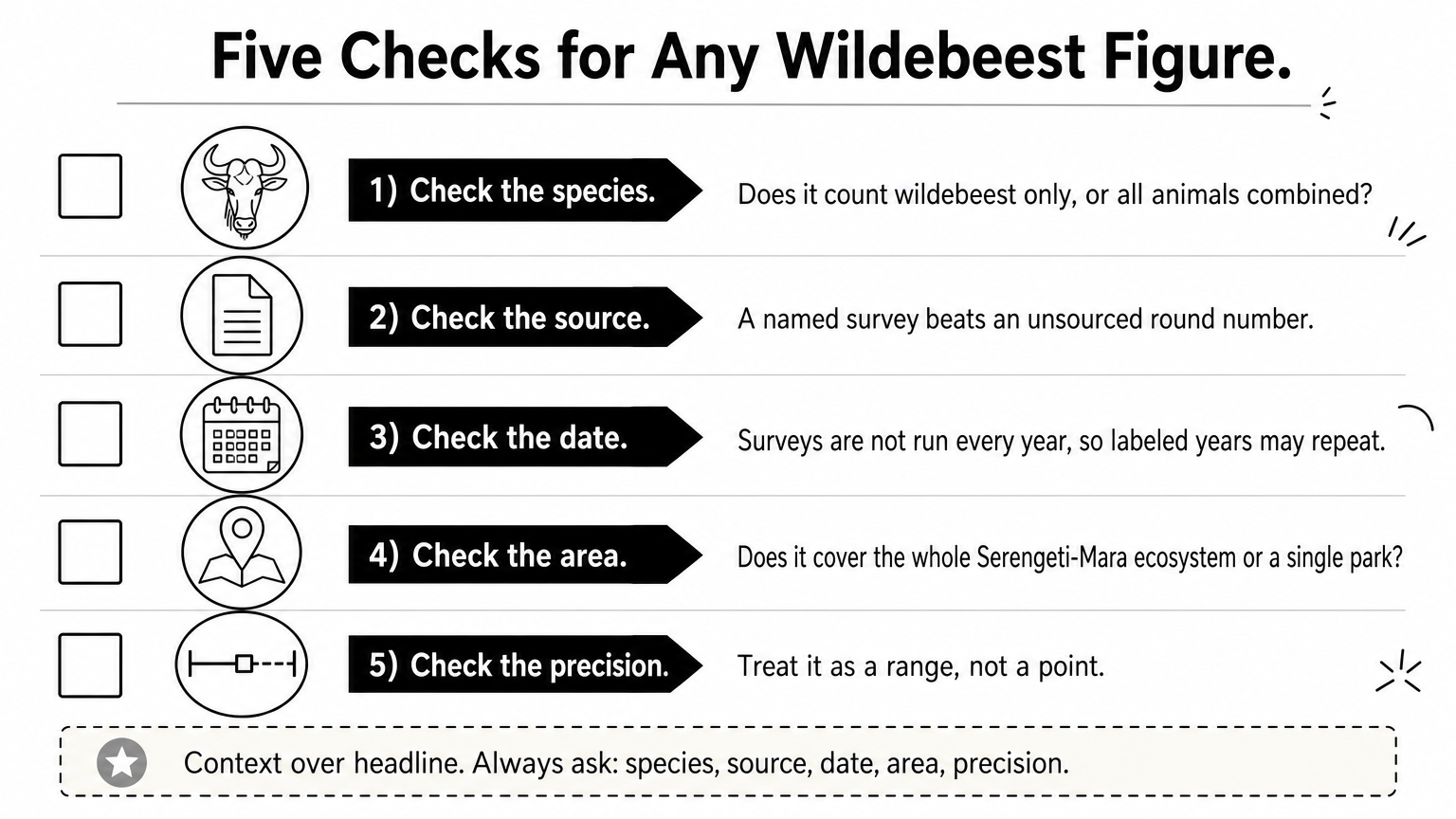
- Species: Does it count wildebeest only, or all animals combined?
- Source: A named survey beats an unsourced round number.
- Date: Surveys are not run every year, so a figure labeled with a specific year often repeats an older survey.
- Area: Does it cover the whole Serengeti-Mara ecosystem or a single park?
- Precision: Treat it as a range, not a point.
Why published numbers range from 600,000 to 2 million
The figures side by side
The spread comes from different methods, different species lumped together, and rounding. Here is how the common figures compare.
| Wildebeest figure | Where you see it | How to read it |
|---|---|---|
| Fewer than 600,000 | Recent scientific reassessment | Revised analysis, well below older estimates |
| 1.2 to 1.3 million | Operator guides, widely repeated | Long-standing estimate of the wildebeest alone |
| 1.5 million | Many travel sites | Often wildebeest, zebra and gazelle combined |
| 2 million | Marketing and popular articles | Round number, usually rounded up |
How two million animals can still be true
A worked example shows how the gaps arise. Take the long-standing estimate of 1.3 million wildebeest, add 250,000 zebra, and assume 400,000 gazelles. That gives about 1.95 million animals, which explains why "about 2 million" circulates. Apply the same companions to a wildebeest count of up to 600,000 and the total falls to up to 1.25 million.
So the numbers disagree for three reasons: different survey methods, different species counted, and rounding for effect. None of them changes the sight itself, which is still among the largest gatherings of land animals on Earth.
Most conflicting figures are not errors; they count different animals, in different years, with different methods.
Zebra, gazelle, calves and losses
Who travels with the wildebeest
Zebra number roughly 200,000 to 300,000. Thomson's gazelles run to several hundred thousand, with smaller numbers of eland and topi in the mix. These companions are not passengers.
Zebra tend to graze the taller grass first, wildebeest follow, and gazelles take the shortest. This grazing sequence is why mixed herds move together.
Calving and losses
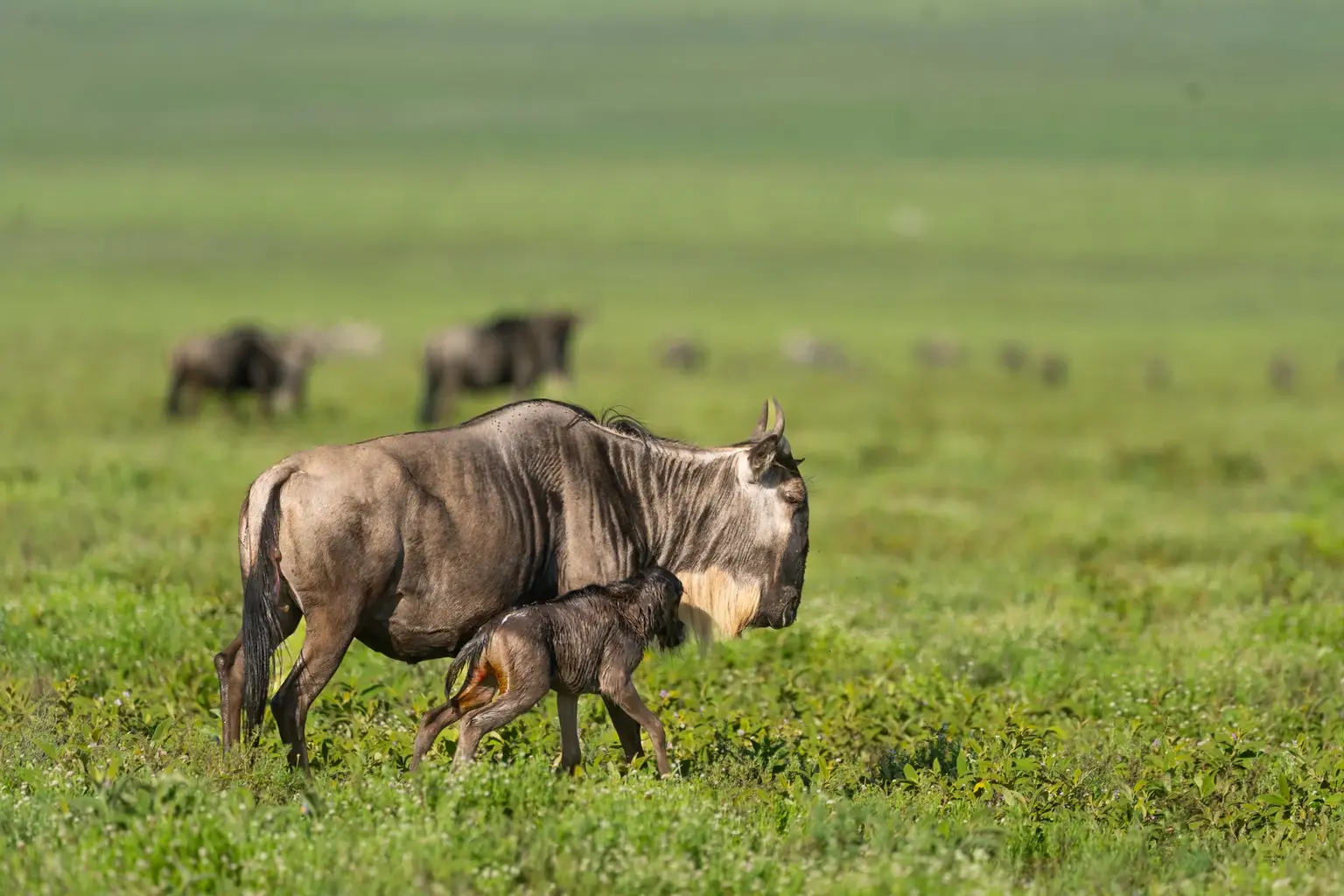
Wildebeest are pregnant for about eight months, and the herd's births are tightly synchronized. Most calves arrive in a few weeks, usually in February on the southern plains around Ndutu. Estimates put it at several hundred thousand calves, often cited near 400,000. Calves stand within minutes of birth and can keep pace with the herd within days.
Losses are large too. Annual deaths are commonly put near 250,000 animals, from predation, thirst, exhaustion and disease, though no one measures this precisely. River crossings are dramatic but are far from the main cause.
Births and deaths each run into the hundreds of thousands every year, so the herd is renewed constantly.
Using the numbers to plan your safari
Match your dates to the herd
Pick your month by the herd's location. The general pattern follows the rains:
- January to March: calving on the southern plains around Ndutu.
- April to June: herds move north-west through the central and western Serengeti.
- July to October: northern Serengeti and the Maasai Mara, with Mara River crossings.
- November to December: herds head back south on the short rains.
Rain shifts these timings by weeks from year to year, so treat the months as guides rather than guarantees.
Choose your dates by where the herd is, not by how big the headline number sounds.
Itineraries built around the herd
For calving, our 8 Days Southern Serengeti Migration Safari is a private trip through Tarangire, the Serengeti, Lake Ndutu, Ngorongoro Crater and Lake Manyara, with February the best month for newborns. If you want the Mara side, the 8 Days Kenya & Tanzania Safari visits Masai Mara, the Serengeti, Ngorongoro Crater, Mto Wa Mbu and Tarangire.
Both are led by a professional private driver/guide and include park fees for non-residents. Tell us your dates and we will check them against where the herds usually are in that month.
The short answer
The long-standing figure is about 1.3 million wildebeest, with a recent reassessment suggesting fewer than 600,000. Add 200,000 to 300,000 zebra and several hundred thousand gazelles. The totals of 1.5 and 2 million usually lump species together or round up. Every figure is a sampled estimate, so read the source before you trust the number.
What matters for your trip is timing and place. The herds are enormous at any estimate, and the right month puts you in front of them. If you want help matching your dates to the herd, plan a private Serengeti migration safari with Passionate Guides Tanzania.